
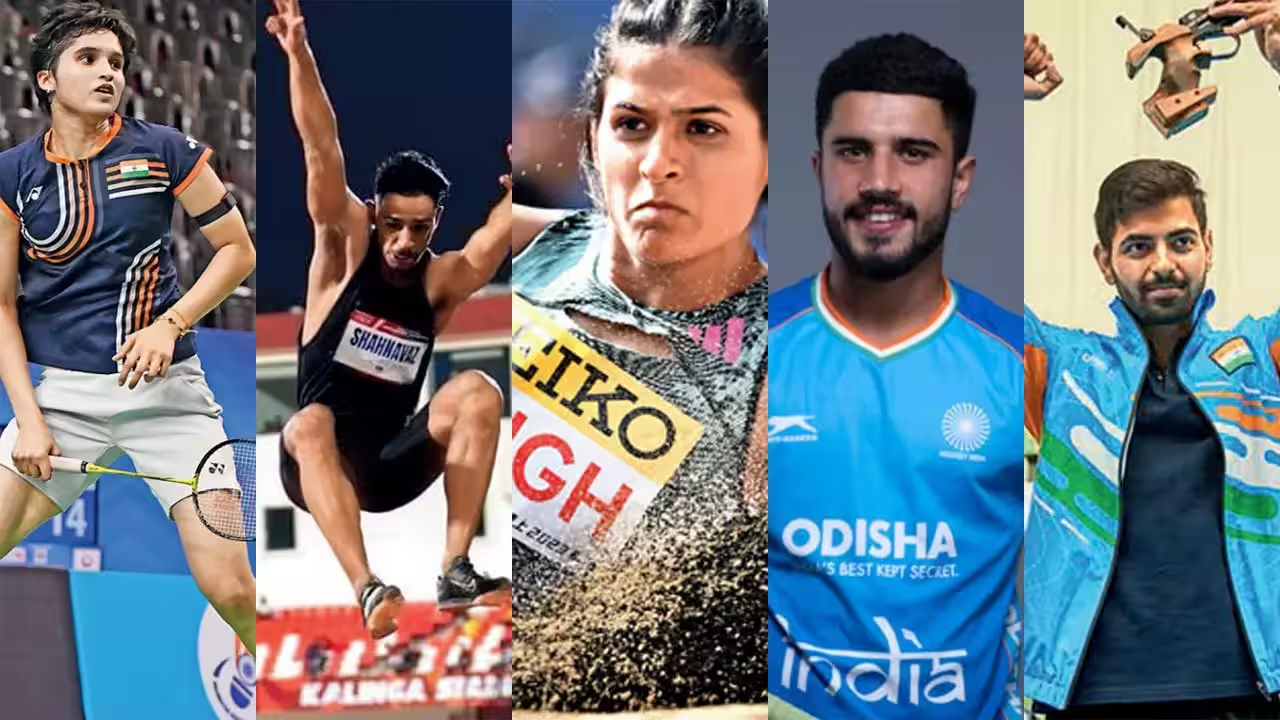
Indian athletics has developed into one of the country’s most important sporting fields, combining a long tradition of track and field competition with a growing generation of internationally competitive athletes. From sprinting and middle-distance running to jumps, throws, race walking, and combined events, Indian athletes participate across a wide range of disciplines. The sport has also gained greater public attention as performances at major international competitions have improved and more athletes have established themselves on the global stage.
The growth of Indian athletics is not simply about individual medals. It reflects changes in coaching, sports science, competition exposure, athlete support, equipment, nutrition, and access to professional training environments. Young competitors from different regions are increasingly able to identify athletics as a serious career option. At the same time, established athletes have helped demonstrate that Indian competitors can compete successfully against strong international fields when they receive sustained preparation and appropriate support.
The current landscape is therefore broader than it was several decades ago. Athletics continues to face challenges involving infrastructure, competition depth, injury management, and access to quality coaching, but the overall ecosystem has become more organized. Understanding this development provides useful insight into how the country’s track and field ambitions may evolve during the coming years.
Historical Development of Indian Athletics
The history of Indian athletics stretches back well before the modern professional era. Track and field competitions became increasingly organized during the twentieth century, with athletes representing India at major international events and national competitions gradually becoming more structured. Over time, events such as the Olympic Games, Asian Games, Commonwealth competitions, and continental championships created opportunities for Indian athletes to measure themselves against competitors from other sporting nations.
Earlier generations often competed with fewer resources than athletes have access to today. Training facilities, sports medicine, nutrition planning, specialist coaches, and international competition opportunities were comparatively limited. Nevertheless, several athletes established important benchmarks and helped create a sporting culture in which athletics could attract younger participants. Their achievements provided examples for subsequent generations and demonstrated the value of disciplined long-term preparation.
The development of Indian athletics accelerated as national sports institutions, state associations, private academies, and professional training programs became more active. Better timing technology, strength and conditioning methods, biomechanics, recovery programs, and competition analysis have gradually become part of high-level preparation. These changes have helped shift athletics from a largely traditional training environment toward a more specialized and data-informed discipline.
The Expanding Range of Track and Field Events
Athletics is often described as a single sport, but it contains numerous disciplines with completely different physical and technical requirements. A sprinter needs explosive acceleration and maximum speed, while a long-distance runner depends heavily on aerobic capacity, pacing, endurance, and efficient energy management. Throwing events require exceptional strength, coordination, technique, and control, while jumping events combine speed, timing, body positioning, and explosive power.
India has traditionally had strong participation in several throwing, walking, and middle-distance disciplines, while sprinting and jumping events have also attracted increasing attention. The broader development of Indian athletics depends partly on ensuring that athletes across all these categories receive suitable training instead of relying on a single standardized approach. A young athlete who shows potential in one discipline may need specialized testing before coaches determine the event most appropriate for their physical characteristics.
Why Event Specialization Matters
Specialization becomes particularly important as athletes progress from junior to senior competition. Basic athletic development can involve running, jumping, mobility exercises, strength work, and coordination drills. At higher levels, however, training becomes much more specific. A hurdler must refine rhythm and barrier technique, a race walker must manage technical efficiency, and a javelin thrower must coordinate the entire kinetic chain from the lower body through the trunk and arm.
This specialization also affects equipment and recovery. Athletes competing in different events require different footwear, surfaces, strength programs, and workload management. A professional athletics system therefore needs coaches and support staff who understand the demands of individual disciplines rather than treating every competitor in the same way.
Major Athletes and the Growth of Public Interest
One of the strongest drivers of Indian athletics has been the emergence of athletes capable of attracting national attention. Successful competitors have helped move athletics beyond the occasional appearance during major sporting events and into regular sports discussions. Their stories often include years of training, setbacks, travel, qualification attempts, injury management, and repeated competition against increasingly difficult fields.
Athletes in throwing events, particularly javelin, have played a notable role in this increased visibility. Neeraj Chopra’s Olympic and world-level achievements have been especially influential in bringing athletics into mainstream Indian sports conversations. His success has encouraged greater interest in javelin and has also contributed to broader discussions about training quality, sports infrastructure, and India’s ability to produce world-class track and field competitors.
However, the development of Indian athletics cannot depend on one athlete. Sustainable progress requires depth across multiple events and age groups. When several athletes are capable of reaching major finals and competitive international standards, the sport becomes less dependent on individual success and develops a stronger overall foundation.
The Role of Grassroots Development
Grassroots programs are essential because elite athletes generally begin developing their skills years before reaching international competitions. Schools, colleges, district-level competitions, state championships, sports academies, and local athletics clubs can all serve as entry points for young competitors. These environments provide opportunities for children to discover whether they enjoy running, jumping, throwing, or other forms of athletic competition.
The challenge is identifying promising athletes without placing excessive pressure on them too early. Young competitors need age-appropriate workloads, technically sound coaching, adequate nutrition, and opportunities to participate in different activities. Excessive specialization or training volume at an early age can create physical and psychological difficulties, while insufficient competition exposure can make the transition to senior athletics more difficult.
A strong grassroots structure should therefore focus on participation as well as talent identification. When more children participate, coaches gain a larger pool from which future high-level athletes can emerge. This approach can also help athletics reach communities where facilities and organized sporting opportunities remain limited.
Training, Sports Science and Athlete Preparation
Modern Indian athletics increasingly depends on more than traditional running or strength sessions. Elite preparation can involve physiotherapy, biomechanics, nutrition, sleep management, strength and conditioning, video analysis, workload monitoring, and psychological preparation. These areas work together because performance at the highest level is often determined by small differences in technique, recovery, and consistency.
For example, a sprinter may analyze acceleration mechanics and ground-contact patterns, while a distance runner may monitor training intensity and recovery indicators. A thrower may use video analysis to refine the sequence of movements leading to release. Such methods allow coaches to identify technical inefficiencies and make adjustments based on measurable information rather than relying entirely on observation.
International exposure is another important part of development. Competing regularly against high-level athletes can teach competitors how to handle different race strategies, competition environments, travel schedules, weather conditions, and pressure situations. Domestic performance provides an important foundation, but international competition offers a different level of experience.
Major Areas Supporting Athlete Development
Several interconnected areas influence the development of Indian athletics. The strength of the sport depends not only on talented athletes but also on the quality of the systems surrounding them.
- Modern training facilities and properly maintained competition surfaces.
- Experienced coaches and specialized technical support.
- Sports medicine, physiotherapy, nutrition, and recovery services.
- Regular domestic and international competition opportunities.
- Effective pathways from junior athletics to senior-level competition.
When these elements operate together, talented athletes have a better opportunity to progress without losing valuable development years. The objective should be continuity: athletes need support not only when they win medals but also when they experience injury, poor form, qualification setbacks, or difficult transitions between competition levels.
Indian Athletics at Major International Competitions
International competitions provide one of the clearest measures of the progress of athletics in any country. For India, events such as the Olympics, World Athletics Championships, Asian Games, Commonwealth Games, and Asian Championships provide different levels of competition and different opportunities for athletes to gain experience.
The Olympic Games carry enormous visibility, but an athlete’s development should not be judged only by Olympic results. World championships, continental competitions, Diamond League meetings, and other international events can provide valuable opportunities to compete against elite fields. Consistent participation at these levels can help athletes improve their rankings, confidence, tactical awareness, and understanding of international competition.
India’s growing presence in international athletics has also increased expectations. As more athletes achieve strong results, attention naturally shifts toward qualification standards, final appearances, podium finishes, national records, and progression across seasons. This creates both motivation and pressure for athletes and their support teams.
Key Competition Levels and Their Importance
| Competition Level | Importance for Athletes | Development Opportunity |
|---|---|---|
| National Championships | Tests domestic performance | Builds consistency and identifies talent |
| Asian Championships | Provides continental competition | Develops international experience |
| Asian Games | High-level multi-sport competition | Tests athletes under major-event pressure |
| World Championships | Elite global competition | Measures performance against the world’s best |
| Olympic Games | Global multi-sport stage | Provides the highest level of international exposure |
Each competition serves a different purpose. Domestic events help athletes establish consistency, while continental competitions provide a bridge toward global competition. World-level championships and the Olympics then provide opportunities to test performance against the strongest competitors from around the world.
Challenges Facing the Sport
Despite its progress, Indian athletics still faces several structural challenges. Access to high-quality facilities is not uniform across the country. Some athletes have access to advanced training centers and specialist support, while others may have to travel considerable distances to find suitable facilities. This difference can affect both talent development and long-term athlete retention.
Coaching depth is another important factor. Elite athletes require specialists who understand the technical details of their individual events, and developing enough qualified coaches across different regions takes time. The transition from promising junior athlete to successful senior competitor can also be difficult because physical development, competition intensity, and performance expectations change significantly.
Injuries represent another major challenge. Athletics involves repetitive physical stress, and inadequate workload management can interfere with an athlete’s development. A professional system must therefore prioritize prevention and recovery rather than focusing only on performance when an athlete is healthy.
The Importance of Women’s Participation
The future of Indian athletics also depends heavily on expanding opportunities for women across all disciplines. Indian women have already produced strong performances in track and field, demonstrating that female athletes can compete at high levels when they receive consistent support and opportunities.

Greater participation at schools and grassroots competitions can increase the talent pool. Women’s athletics also benefits when training facilities, travel opportunities, coaching, nutrition support, and competition schedules are designed to provide a professional environment. Visibility matters as well because successful female athletes can encourage younger competitors to view athletics as a realistic sporting pathway.
Building stronger women’s participation is not simply about increasing numbers. It involves creating sustainable pathways from junior competition to senior international events and ensuring that talented athletes can continue developing throughout their careers.
Technology and the Future of Athletic Performance
Technology is likely to become increasingly important in the future of Indian athletics. Wearable devices, high-speed video, motion analysis, performance tracking, and digital training platforms can help coaches understand how athletes respond to different workloads. Data can also support recovery decisions and help identify patterns that might otherwise be missed.
However, technology should complement coaching rather than replace it. Athletic performance involves physical ability, technical skill, competition experience, confidence, and individual circumstances. The most effective approach is likely to combine objective measurements with experienced human judgment.
India also has an opportunity to develop stronger domestic expertise in sports technology. Universities, sports institutes, technology companies, and athletics organizations could collaborate on tools designed for local training environments. Such cooperation could make advanced performance analysis more accessible to a wider group of athletes.
What the Next Generation Can Learn
Young athletes entering the sport can learn valuable lessons from the development of Indian athletics. High-level performance rarely comes from a single successful competition. It usually develops through years of consistent training, technical improvement, recovery, competition experience, and adaptation.
Patience is particularly important. A promising junior athlete may not immediately become a successful senior competitor, and short-term results do not always predict long-term development. Athletes, parents, coaches, and institutions need to recognize the importance of gradual progression.
Education should also remain part of an athlete’s development. Academic skills, communication, financial awareness, and career planning can provide valuable stability throughout and after a sporting career. A strong sporting system should support athletes as complete individuals rather than viewing them only through competition results.
Future Prospects for Indian Track and Field
The future of Indian athletics will depend on whether recent progress can be converted into sustainable depth. More athletes reaching international standards across different events would strengthen India’s overall competitive position. This requires continued investment in facilities, coaching education, sports science, grassroots programs, and international exposure.
Another important factor will be consistency. Producing an exceptional athlete is valuable, but developing several generations of competitive athletes is a much larger achievement. Strong domestic competitions can create healthy competition among athletes and provide coaches with more opportunities to identify emerging talent.
The coming years may therefore bring greater attention to events that have historically received less visibility. Sprinting, middle-distance running, jumping events, race walking, hurdles, and combined events all offer opportunities for development. With appropriate technical support and a sufficiently large talent pool, progress can occur across a much broader section of the sport.
Conclusion
Indian athletics has moved through a significant period of development, evolving from a sport largely followed during major competitions into a field with increasingly visible athletes, stronger professional systems, and greater public interest. Success in international competitions has helped raise the profile of track and field, while improvements in training, sports science, facilities, and athlete support have created better conditions for sustained development. The next stage will require patience and a long-term approach. Grassroots participation, specialized coaching, women’s development, injury prevention, international exposure, and modern performance analysis all have important roles to play. The objective is not simply to produce occasional champions but to build a deeper and more sustainable athletics ecosystem.

